2026 Report
Short-Term Exchange Students
International Students Visited Kushiro City Hall and Participated in a Local Study Tour
Kushiro National College of Technology accepts short-term exchange students from overseas partner institutions. In addition to conducting research activities in their respective academic fields, the students also participate in exchange activities designed to deepen their understanding of the Kushiro region. This time, the students paid a courtesy visit to Kushiro City Hall and took part in a local study tour around Lake Akan.
1. Short-Term Exchange Students Paid a Courtesy Visit to the Deputy Mayor of Kushiro City
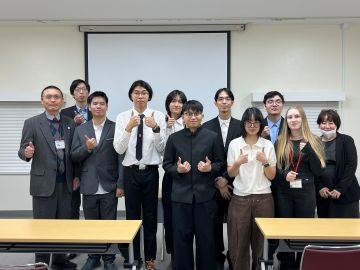
Eight short-term exchange students currently studying at our college, together with three long-term international students who transferred to our college this academic year, paid a courtesy visit to Kushiro City Hall.
During the visit, each international student introduced themselves to the Deputy Mayor, speaking about their home country, home university, studies at our college, and expectations for their life in Kushiro. They also exchanged views on Kushiro’s natural environment and local culture. The visit was a valuable opportunity for the students to deepen their understanding of the local community.
2. Short-Term Exchange Students Participated in a Local Study Tour at Lake Akan
A local study tour was held for international students and students of our college.
The participating international students deepened their understanding of the attractions of the Kushiro region while experiencing the rich natural environment of Lake Akan, including “Bokke” mud volcanoes and “Marimo” algae balls, as well as local culture such as Ainu culture.
Japanese students also joined the tour, making it a meaningful opportunity for students to interact with one another through travel and sightseeing.
Short-Term Exchange Students Experienced and Learned about Japanese Culture through Interaction with Our Students
At our college, special classes are offered mainly for short-term exchange students to help them deepen their understanding of Japanese culture, in addition to their research activities in their respective academic fields. This time, as part of a “Japanese Culture Experience Week,” the students participated in tea ceremony, calligraphy, and flower arrangement classes.
1. Short-Term Exchange Students Learned about Japanese Culture through a Tea Ceremony Experience
As part of their Japanese cultural learning, a special tea ceremony class was held with the support of students from the Tea Ceremony Club.
After receiving an explanation of the basic manners and procedures of tea ceremony, the international students experienced Japanese traditional culture by drinking tea in the proper manner. Many of the students were experiencing tea ceremony for the first time. They showed great interest in the manners and movements involved, and the activity was conducted in a warm and relaxed atmosphere.
2. Short-Term Exchange Students Learned about Japanese Culture through a Calligraphy Experience
As part of a special class on Japanese culture, a calligraphy experience was held for short-term exchange students with the cooperation of students from the Calligraphy Club.
In the class, the students first received an explanation of how to use calligraphy tools such as brushes, ink, and hanshi paper. They then tried writing Japanese characters with brushes.
Although many students were not used to handling a brush, they carefully wrote each stroke and showed interest in Japanese characters and the expressive qualities of calligraphy.
The students also shared their completed works with one another, and the activity was held in a friendly and relaxed atmosphere. For the international students, the calligraphy experience became a valuable opportunity to encounter Japanese traditional culture and written culture.
3. Short-Term Exchange Students Experienced Japanese Traditional Culture through Flower Arrangement
As part of a special class on Japanese culture, a flower arrangement experience was held for short-term exchange students.
In the class, an external instructor explained the basic concepts of flower arrangement and how to handle the materials. The students then tried arranging flowers themselves.
They worked on creating their own arrangements while considering the direction and height of the flowers, as well as the overall balance of the composition. Many students were experiencing flower arrangement for the first time, and they showed interest in the beauty of nature and the expression of space in Japanese traditional culture.
By appreciating one another’s completed works, the students deepened their understanding of Japanese culture in a warm and relaxed atmosphere.
We would like to express our sincere appreciation to the members of the Tea Ceremony Club for their kind cooperation.